Brasil
 Europe
 By
By 
The technology sector’s circular economy ambitions are expanding beyond refurbishment, repair and recycling, as a relatively new model gains momentum: waste reduction as a service. Recent developments involving brands such as Google, Back Market and GSMA boosting or using the model. After being introduced already in 2016, this suggest the service is moving into the mainstream of tech’s commercial and environmental strategies.
At the centre of both stories is Closing the Loop, the company linking new device sales with measurable e-waste collection on a ‘One for One’ basis. Its latest partnerships with Google and GSMA show that brands and industry bodies are seeking more customer-centric, visible and scalable ways to strengthen their circular agendas.
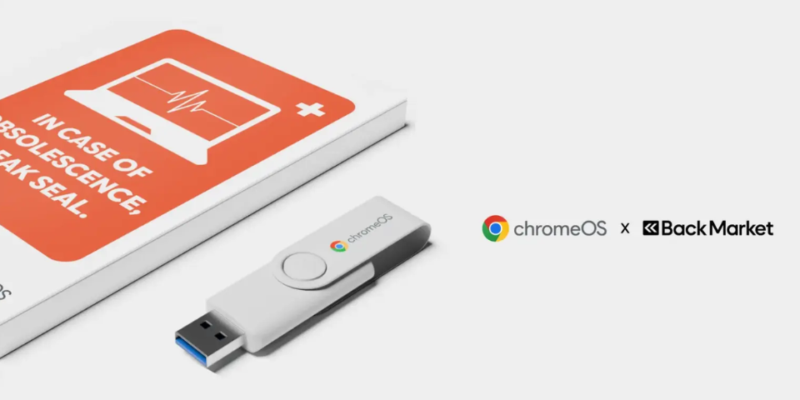
One of the most recent examples is the collaboration between Google and Back Market around USB sticks preloaded with ChromeOS Flex, Google’s operating system designed to give unsupported laptops a second life. Instead of replacing ageing devices, users can extend the life of existing hardware.The initiative goes further than device longevity alone. Every USB stick sold is linked to the collection of an equivalent amount of electronic waste through Closing the Loop.
The result is a proposition that combines product utility with immediate environmental action. Consumers receive a practical tool to revive an old laptop while also contributing to waste reduction in a simple and understandable way.
Joost de Kluijer, Co-founder and CEO of Closing the Loop, said:
“The success of a commercial and circular strategy is largely defined by how compelling, understandable and visible it is. It’s great to support our customers on their closed loop ambitions, by adding an element that is immediate, logical and business-supporting.”
His comments reflect a broader challenge for the sector. Many sustainability programmes remain too abstract for customers to connect with. Models that combine clear consumer value with visible impact are more likely to gain traction. A second development points to far wider adoption. GSMA has signed a Memorandum of Understanding with Closing the Loop to offer One for One as a GSMA Industry Service. When implemented, the move could make waste reduction as a service more accessible across the global mobile ecosystem. Given GSMA’s influence across operators, manufacturers and mobile stakeholders, the agreement is being seen as a sign that the model can scale beyond individual product launches.
That is significant because many sustainability initiatives work well in pilot phases but struggle to expand across markets and supply chains. Industry-backed frameworks can help simplify adoption and accelerate deployment. Together, the recent two announcements mark an important shift. A leading consumer technology brand and one of telecom’s most influential organisations are both backing a model that connects commercial propositions with measurable environmental outcomes.